Wedding hat etiquette in the UK: who wears one, when to take it off and what the rules actually are
At a British wedding a hat is expected of the mother of the bride and the mother of the groom, welcome on any woman attending a daytime ceremony and optional for everybody else. A woman keeps her hat on indoors. A man takes his off. Hats come off when the evening reception begins. None of this is a published rule the way the Royal Ascot dress code is, so read the invitation first and the room second.
What follows is the etiquette a London milliner is asked about every wedding season, set out question by question.
Who is expected to wear a hat at a UK wedding?
Nobody is required to wear one. The two guests everybody expects to see in a hat are the mother of the bride and the mother of the groom, because they stand in the formal photographs, they greet arriving guests and they set the level of formality the rest of the family dresses to. After that it comes down to the dress code on the invitation and how formal the ceremony is.
The mothers and the grandmothers
Both mothers wear headwear at a formal daytime wedding as a matter of course, and grandmothers usually follow. The piece lifts the outfit to the register of the day and makes them findable in a crowd of two hundred people. A grandmother often wants less weight and less brim, so a shallow pillbox or a light percher carries the occasion across a long afternoon.
The bridal party
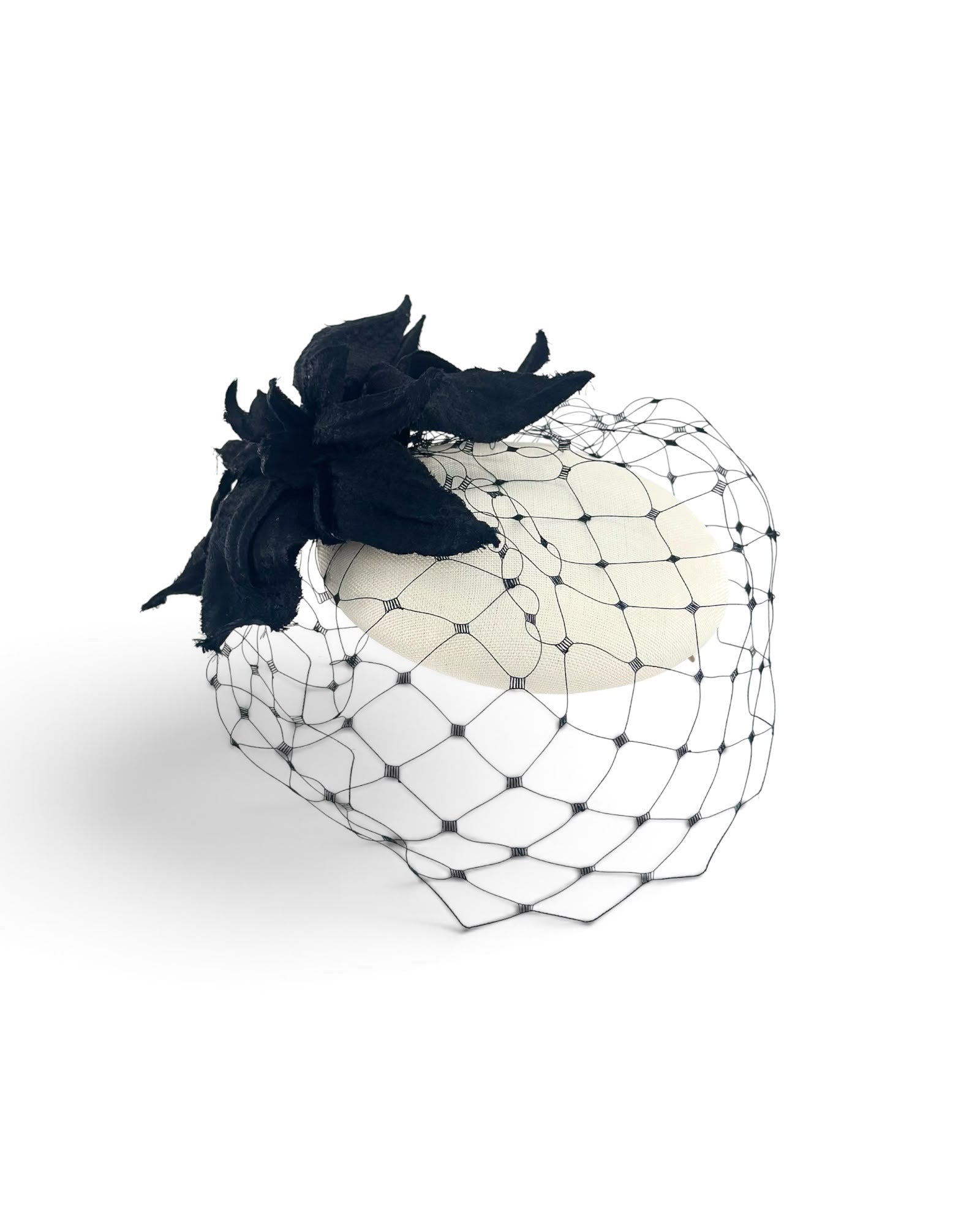
Brides in Britain rarely wear a hat with a full-length gown, and when they do it is usually a shallow shape or a veiled piece that sits with the dress rather than competing with it. A short dress, a register office ceremony or a second marriage changes that calculation, and a sculptural piece can become the whole look. Our bridal pieces are shapes built to sit alongside a veil or to replace one.
Bridesmaids are usually left bare-headed or given something small and matched, because a row of brims behind the bride pulls the eye away from her. If the couple asks the bridal party to wear headpieces, keep the scale identical across all of them.
Guests
A female guest at a daytime church or country house wedding is on safe ground in a hat, a percher or a headpiece. It reads as effort rather than obligation. Scale is the only real judgement call, and the guiding principle is that no guest should out-dress either mother. Our wedding guest hats and headpieces are grouped for this decision.
Men
A man wears a hat at a British wedding only when the invitation asks for morning dress, and then it is a grey or black top hat. Most men carry it rather than wear it, and it is removed indoors without exception. A soft felt or straw hat sits outside a formal UK wedding outfit.
Does the time of the wedding change what you wear?
Yes. Formality in British dressing is tied to daylight. A ceremony that starts before four in the afternoon is daywear, and daywear is where hats belong. An evening ceremony moves the outfit toward cocktail dressing, where a headpiece, a comb or a headband sits more comfortably than a brim.
A morning ceremony
A morning wedding, typically eleven o'clock to one, is the most formal slot in the British calendar and the one that invites morning dress. Light is high and hard at that hour, which flatters structure. A wide brim with a clean edge, a deep pillbox or a disc worn at an angle all photograph well before noon. Choose a material with texture, because parasisal straw and fine felt hold their sculpting in bright sun where a flat shiny surface glares.
An afternoon ceremony
Between one and four is the most common British wedding slot and the most forgiving. Anything from a wide brim to a small percher is correct. Colour matters more here than scale, because the light warms through the afternoon and a shade chosen under a shop light reads differently at five.
An evening ceremony
A ceremony after six is evening dress territory and a brimmed hat starts to look out of place. This is where a headpiece, a veiled cocktail piece or a sculptural headband earns its keep, because it holds the sense of occasion without daytime weight. Browse the headbands and fascinators for the shapes that work under low light.
Does a church, a register office or a country house change the rules?
The venue changes the register more than the rules. A church ceremony is the most formal setting and the one where a hat looks most natural. A register office is shorter, plainer and usually smaller, so scale down. A country house or a marquee sits between the two and gives colour more room to work.
A church wedding
Covering the head in church is an old courtesy and it is why hats and weddings became attached to each other in Britain. Church interiors are dim, so a pale shade or a light trim keeps your face visible in the photographs. Watch the brim width against a narrow pew and a low door.
A register office or town hall
These ceremonies are brief and the rooms are small, often with everybody seated close together, so a wide brim blocks the view of the people behind you. A pillbox, a percher or a small disc gives you the occasion without the obstruction and survives the signing table and the group photograph on the steps.
A country house, a marquee or a garden
Outdoor weddings are the best possible use of a wide brim, because there is space around you and shade is genuinely useful. Grass and heels lower your effective height, so scale accordingly. Wind is the real enemy, and a hat for an exposed lawn has to be fitted and secured properly.
When does a hat go on and when does it come off?
Put your hat on before you leave for the ceremony and keep it on through the service, the receiving line, the drinks and the photographs. Take it off when the evening reception begins and the dancing starts. A woman keeps her hat on indoors throughout the daytime part of a wedding. A man removes his the moment he steps inside.
Do women keep hats on indoors?
Yes. This is the most asked question about wedding hats and the answer has not changed. A woman's hat is part of her outfit for the whole daytime event, so it stays on inside the church, inside the reception room and through the wedding breakfast. Removing it partway through leaves flattened hair and an outfit that suddenly looks unfinished.
Do men keep hats on indoors?
No. A man removes his hat indoors, at the church door, and during any outdoor moment with formality attached such as photographs or a toast. A top hat worn with morning dress is carried in the left hand indoors, which is why the shape has a flat brim you can hold cleanly.
What should you do with your hat during the meal?
Keep it on. A wedding breakfast is a formal daytime meal and a woman's hat stays on through it, including the speeches and the toasts. The exception is practical. If your brim reaches your neighbour's place setting or blocks the view of the speeches for the table behind you, take it off between courses and put it somewhere safe.
Where to put a hat you have taken off
Rest it crown down on a spare chair or a clean flat surface away from the table, never on the dining table itself and never brim down. A blocked brim carries the shape of the hat, and pressing it flat is how a good piece loses its line. Most venues will store it properly if you ask.
What does the mother of the bride wear?
The mother of the bride wears a hat or a substantial headpiece that sits inside the wedding palette while holding a shade of its own, so she is distinct in every photograph. She usually chooses first, because the mother of the groom then dresses to the level she has set. Traditionally she avoids white, ivory and cream, and she avoids the exact colour the bridesmaids are wearing.
Structure is worth more to her than novelty. She stands for the receiving line and appears in more pictures than any guest, so the piece has to be secure, comfortable across a long day and flattering from behind as well as from the front. Our mother of the bride hats are colour matched with that day in mind.
What does the mother of the groom wear?
The mother of the groom follows the level the mother of the bride has set, then chooses a different shade within the same palette. Matching the formality matters. If the bride's mother wears a wide brim, a fascinator on the groom's side will read as underdressed in the group photograph, and the reverse is just as visible.
The advantage on the groom's side is time. Because the bride's mother usually confirms her outfit first, the groom's mother knows the register and the palette before she commits, which makes a precise colour match straightforward. Any piece in the house can be made in another colour, so the shade is matched to a swatch of the outfit fabric. Start with the mother of the groom hats.
Should the two mothers coordinate?
Yes on formality and palette. No on the exact colour. Agree three things before either of you buys: the level of formality so both hats share a register, the colour family drawn from the wedding palette, and the scale of the headwear so neither mother is outsized by the other. Then each mother takes her own shade a few tones away from the other.
The reason is the photographs. Two mothers in the same dusty rose read as a uniform and neither stands out. Two mothers in the same register but different shades, say a deep berry against a soft champagne, both belong to the day and both stay individually visible.
Hat, fascinator or headpiece: which one does a wedding ask for?
All three are correct at a British wedding and the choice is about formality and scale. A hat has a crown and a brim and reads most formal. A fascinator is a light decorative piece on a clip or a band. A headpiece, percher or cocktail hat is a sculpted shape with a base that sits on one side of the head and lands between the two.
A hat
Choose a hat for a church ceremony, a morning wedding, a formal country house wedding or any invitation that mentions morning dress. It is also the right answer for either mother at a traditional wedding. The brim frames the face and gives shade, and a blocked crown holds its line where a soft shape collapses by four o'clock.
A fascinator
A fascinator suits a less formal wedding, a warm day and anyone who finds a brim uncomfortable. It is welcome at most British weddings. One hard boundary catches people out. The Royal Enclosure at Royal Ascot asks for a hat or headpiece with a solid base of at least 10cm in diameter, and fascinators are not permitted there. That is a race day rule with no bearing on weddings, and the two occasions get conflated constantly.
A percher, a cocktail hat or a headpiece
This is the most versatile category. A sculpted piece worn on one side gives the drama of a hat at a fraction of the weight, it clears a seated meal, it works indoors and outdoors and it photographs with real depth when veiling is added. It suits shorter hair, city weddings and an outfit that has to carry into the evening.
A headband
A sculptural headband is the lightest option and reads best after dark. It is the correct answer for an evening ceremony, a second-day celebration or a guest who wants something they will genuinely wear again. See the headbands and fascinators for the range of scale available.
Can you wear black to a wedding?
Yes. Black is accepted at British weddings now, particularly for evening ceremonies, city weddings and anything with a black tie line on the invitation. The old objection came from mourning dress and it has faded. The only real risk is a head-to-toe black outfit under grey British light, which photographs as a silhouette and loses all the detail you paid for.
The fix sits on your head. A black outfit with a hat in a strong colour, or a black hat lifted with a coloured trim, veiling or a silk flower, keeps the shape readable. Texture does the same work, because a black felt or a black straw with a visible weave holds its sculpting where flat black fabric goes dead.
Can you wear white, ivory or cream to a wedding?
Leave white, ivory and cream to the bride unless the couple has asked for something different. It is the one convention that still causes genuine offence, and it applies to the hat as well as the outfit. A cream hat above a coloured dress is a smaller risk than a cream dress, and in a photograph beside the bride it can still read as competing.
Two situations change the answer. Some couples ask guests to wear white deliberately, and some cultures treat white as the standard celebratory colour, so the invitation governs. If you are unsure, a pale champagne, a soft blush or a warm oyster tone gives you the same lightness while staying clearly separate from bridal white.
How does a brim behave in photographs?
A brim controls light on your face, and that is the whole of it. Worn level and low it drops a hard shadow across the eyes in bright sun. Worn tilted, so the brim clears the eyeline on one side, it frames the face and lifts the whole picture. Every experienced wearer tilts.
Brim shadow across the eyes
Outdoor midday photography is where hats go wrong. A wide brim worn straight puts your eyes in shade while the rest of the frame is in full sun, and no amount of editing recovers them. Angle the hat up on one side, or choose a brim with an upswept edge, so light reaches the face. An upturned brim also opens the face to the camera from a three-quarter angle.
The group photograph
Group shots are where scale gets settled. Anyone in a very wide brim in the second row disappears behind the row in front. If you will be in the formal family photographs, choose a shape with height at the front rather than width at the sides, because height reads in a line-up.
Wind, confetti and the church door
The two moments a hat is most likely to move are the walk from the car and the confetti at the door, and both are photographed. A piece fitted to your actual head measurement will hold. Tell your milliner how you plan to wear your hair, because an updo, a low chignon and a soft blow dry each change where the fixings go.
How far ahead should you order a wedding hat?
Confirm the outfit first, then allow one to four weeks for a piece made to order in the London atelier, from the first conversation to the finished hat. Wedding season and Ascot are the busiest weeks of the year in the workroom, so start earlier if your date falls between May and September.
Ordering after the outfit is settled is what makes a precise colour match possible. Post a swatch of the outfit fabric and the colour is matched against the cloth itself rather than guessed from a photograph on a screen. Every piece is made by hand in London, one of one, in any colour.
Questions
Do you have to wear a hat to a wedding in the UK?
No. A hat is expected of the mother of the bride and the mother of the groom at a formal daytime wedding, and it is optional for every other guest. Read the invitation. Morning dress or a church ceremony points strongly toward headwear, and an evening or informal wedding does not.
Do women take their hats off indoors at a wedding?
No. A woman keeps her hat on indoors throughout the daytime part of a wedding, including the church, the receiving line and the wedding breakfast. The convention only ends when the evening reception begins. A man removes his hat as soon as he steps inside, which is the opposite rule.
When should you take your hat off at a wedding?
At the start of the evening reception, when the daytime dress code ends and the dancing begins. Take it off earlier if it is genuinely in the way at a seated meal or if it becomes uncomfortable across a long day. Rest it crown down on a chair, never brim down and never on the dining table.
Can you wear a hat to a register office wedding?
Yes, and a smaller shape works better. Register office ceremonies are short and the rooms are small with close seating, so a pillbox, a percher or a small disc gives you the occasion without blocking anybody's view. Save the wide brim for an outdoor or country house ceremony where there is space around you.
Should the mother of the bride and the mother of the groom match?
They should match on formality and palette while wearing different shades. Two hats in the same colour read as a uniform in the photographs and neither mother stands out. Agree the register, the colour family and the scale of the headwear in advance, then each mother chooses her own shade a few tones apart.
Who chooses their outfit first, the mother of the bride or the mother of the groom?
The mother of the bride chooses first by convention, and the mother of the groom then dresses to the level she has set. This is a courtesy rather than a rule, and it exists so the two outfits share a register. It also gives the groom's side a confirmed palette to colour match against.
Is a fascinator acceptable at a wedding?
Yes, at most British weddings a fascinator is welcome, particularly at less formal or warm weather celebrations. The restriction people confuse it with belongs to racing. The Royal Enclosure at Royal Ascot requires a hat or headpiece with a solid base of at least 10cm in diameter and does not permit fascinators, which is a race day rule only.
What is the difference between a hat, a fascinator and a headpiece?
A hat has a crown and a brim and reads most formal. A fascinator is a light decorative piece mounted on a clip or a band with no structured base. A headpiece, percher or cocktail hat is a sculpted shape with a base that sits on one side of the head, giving the presence of a hat with less weight.
Can you wear black to a wedding?
Yes. Black is accepted at British weddings, especially for evening and city celebrations. Avoid an unbroken black outfit under grey light, because it photographs as a flat silhouette. Lift it with a hat in a strong colour, or with veiling, a coloured trim or a textured felt or straw that keeps the sculpting visible.
Can a guest wear white or cream to a wedding?
Leave white, ivory and cream to the bride unless the couple has asked otherwise. The convention covers the hat as well as the dress. If you want that lightness, a pale champagne, a soft blush or a warm oyster reads as light in photographs while staying clearly separate from bridal white.
How wide can a wedding hat brim be?
Up to roughly the width of your own shoulders keeps you clear of your neighbours at a seated meal and in a group photograph. Wider than that suits an outdoor ceremony with space around you. Tilt any brim so it clears your eyeline, otherwise it drops a hard shadow across your eyes in every outdoor photograph.
How long does it take to order a wedding hat?
Allow one to four weeks from the first conversation to the finished piece for a hat made to order in the London atelier. Confirm your outfit first so the colour can be matched to a swatch of the fabric. Start earlier for a wedding between May and September, when the workroom is at its busiest.
Tell us about your wedding and we will guide you to a shape and a shade that suit the day, your outfit and your role in it. Every piece is designed and made by hand in the London atelier, one of one, in any colour you choose.
Shop by role
Every piece is designed and made by hand in the London atelier.