The mourning veil: where it comes from and who wears one now
The veil is the piece people ask for most when there has been a death, and it is the one they are least sure they are allowed to wear. It carries more meaning than anything else a milliner makes, and almost all of that meaning was fixed in Britain in the nineteenth century. Knowing where it came from makes it much easier to decide whether it is yours to wear.
Where the mourning veil comes from
Covering the face in grief is far older than millinery, but the version we recognise is Victorian. Mourning dress in nineteenth century Britain was set out in detail, published in etiquette manuals and sold from warehouses that dealt in nothing else. Queen Victoria fixed the tone. After Prince Albert died in 1861 she wore mourning for the remaining forty years of her life, and what the Queen did, the country copied.
A widow's mourning ran in stages. Full mourning came first, for roughly a year and a day, and it required black crape, a crimped silk gauze with no shine in it at all. Second mourning followed, when the crape could be reduced. Then half mourning, when grey, mauve and soft purple were allowed and a woman could be seen in something other than dead black. The long crape veil belonged to that first stage. It fell over the face and often to the waist or below, and it told anyone who saw her exactly where she stood in that calendar before a word was spoken.
What the veil actually did
Two things at once. It marked the wearer, so that strangers knew to leave her alone, and it hid her, so that she could be in public without her face being read. Neither job has changed. A woman standing at the front of a crematorium chapel this week is doing what a widow did in 1875, and it works for the same reason.
The material mattered as much as the shape. Crape was deliberately dull, stiff and unlovely. Anything that shone was thought disrespectful, which is why jet, a matte black fossilised wood polished at Whitby, became the only jewellery a woman in full mourning could wear. That instinct, that shine is wrong and matte is right, is still the most reliable rule there is for dressing for a funeral.
How the rules ended
Victorian mourning dress did not fade so much as collapse, and the First World War is what broke it. When a country loses a generation, a code that puts every bereaved woman into black crape for a year stops reading as respect and starts reading as a uniform nobody can take off. The scale of the losses, the cost of the fabric and a general reaction against Victorian formality finished it between them. By the 1920s the long veil had gone. Only the short one survived.
The birdcage veil
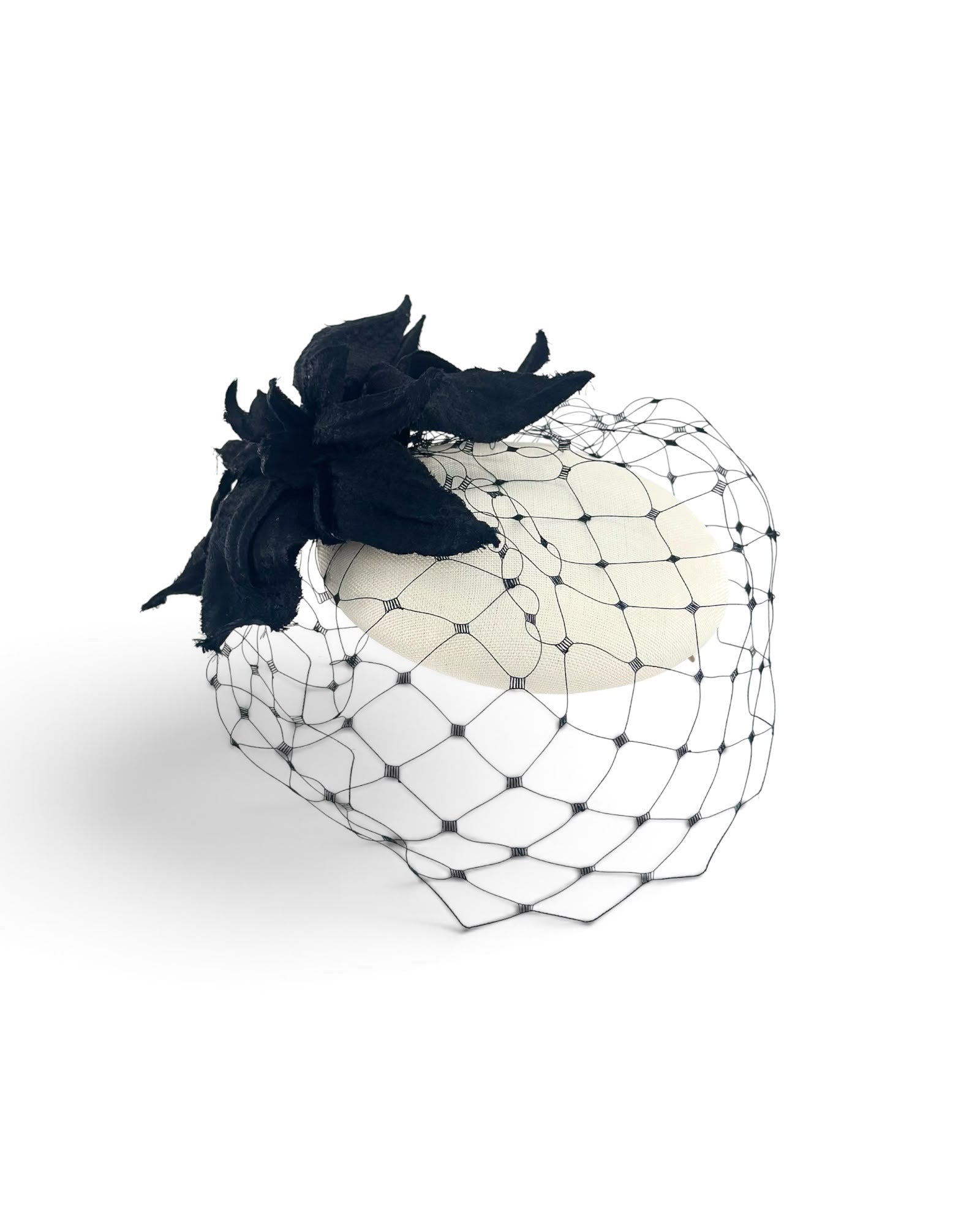
What most people mean by a mourning veil now is a birdcage veil: a short piece of net, gathered at the crown or fixed to a band, a comb or a hat, falling to the eyes, the cheekbone or the chin. Milliners call the material veiling, or French net. It comes in different gauges, from a fine mesh you can barely see in a photograph to a wide diamond net that lays a pattern of shadow across the face.
It is a small thing to make and a difficult one to make well. The net has to be cut on the right grain or it will refuse to curve around the head. It is gathered by hand, wired at the edge where a shape is wanted, and stitched to the base so that it holds a soft arc and stands away from the skin. Done properly you can see out of it perfectly and nobody can quite see in.
Who wears one now
Two funerals fixed the image for most people. Jacqueline Kennedy wore a black veil at her husband's funeral in November 1963, and it became the photograph of American grief. In April 2021 Queen Elizabeth II sat alone at Prince Philip's funeral in a black hat with a face veil, and the same thing happened again.
What those two have in common is that the woman under the veil was the widow. That is the convention and it holds. A face veil at a funeral reads as immediate family: the widow, the mother, the daughter, the sister. Nobody will enforce it and there is no register of who is entitled to one. But if you are a colleague or a friend of the family, a veil can look like stepping into a role, and being looked at is the last thing anyone wants that day.
If you are close family, wear one without hesitating. It is practical as much as it is symbolic. There is a stretch of a funeral, usually the walk in and the first ten minutes, when you have no control over your face at all. A veil gives you somewhere to put it.
How to wear one without it looking like costume
- Keep it short. To the chin at the longest. A veil below the collarbone belongs to 1890 and reads as theatre now.
- Keep the net plain. Plain black French net. Chenille dots, heavy embroidery and scattered crystal all pull the eye and undo the point of the thing.
- Match the base to your hair where the veil sits on a band, so the band disappears and only the net is seen.
- Wear nothing else that shines. Matte fabric, matte shoes, small earrings. The Victorians were right about this.
- Try it on before the day. A veil changes how close people come to you, and how you manage a cup of tea afterwards. Ten minutes at home is enough to know.
Fit, and what it sits on
A veil is only as good as the base under it. On a band or a comb there is no size to worry about, because a headpiece is shaped to sit securely on any head. On a hat the measurement matters, and the method for taking it is on the size and fit page. Take the measurement over the hair you expect to wear on the day, since a chignon adds close to a centimetre.
If there is a service this week
Veiled pieces are held in stock and dispatched from the London atelier. Delivery within the United Kingdom takes 48 hours of despatch and there is no express service. A piece blocked to your own measurement takes one to four weeks. If your date is closer than that, write before you order and we will tell you honestly what can be done.
The practical guide to the rest of it, whether a hat is expected at all, what counts as dark enough and what to wear to a memorial, is on our what to wear to a funeral page. The pieces are in the funeral collection, and the veiled shapes across the house are gathered under hats with veils.