Choosing a hat colour that photographs well at races and weddings
The hat colour that photographs well is usually a mid tone with some depth in it, made in a material that has texture. Very pale colours lose their edges in bright sun and very dark ones flatten into a silhouette, so the sculpting disappears in the pictures you keep. Judge any colour outdoors, in daylight, held against your own face, before you commit to it.
A race day or a wedding is photographed all day, and the piece has to hold up on a phone at midday and on a long lens from across a lawn.
How does bright sun change a hat colour compared with overcast British light?
Direct sun is a small, hard light source. In June it sits high overhead and lifts anything pale to the top of the camera's range. The camera meters the whole frame, so when the hat is the brightest large area in it the exposure is pulled down and your face goes with it.
Cloud turns the whole sky into the light source. Shadows go weak, contrast drops and the cast turns slightly blue. Pastels that looked delicate indoors go chalky, while saturated mid tones hold their identity.
In practice:
- Midsummer, strong sun. Mid tones with texture. A straw weave, a tonal trim and a matt surface give the camera something to hold on to.
- Flat grey day. Saturated colour. Deep red, emerald, burgundy, violet and true blue carry through low contrast light where a soft blush looks washed out.
- Church then garden. Colour with depth survives the move from a dim interior to open air.
Why do very pale hats look blown out in photographs?
A camera sensor has a ceiling. Once a bright area reaches it the information is gone and no editing brings it back. Optic white, ivory silk and bleached straw hit that ceiling quickly under sun, and what comes back is a flat white shape with no crown, no seam and no visible bow.
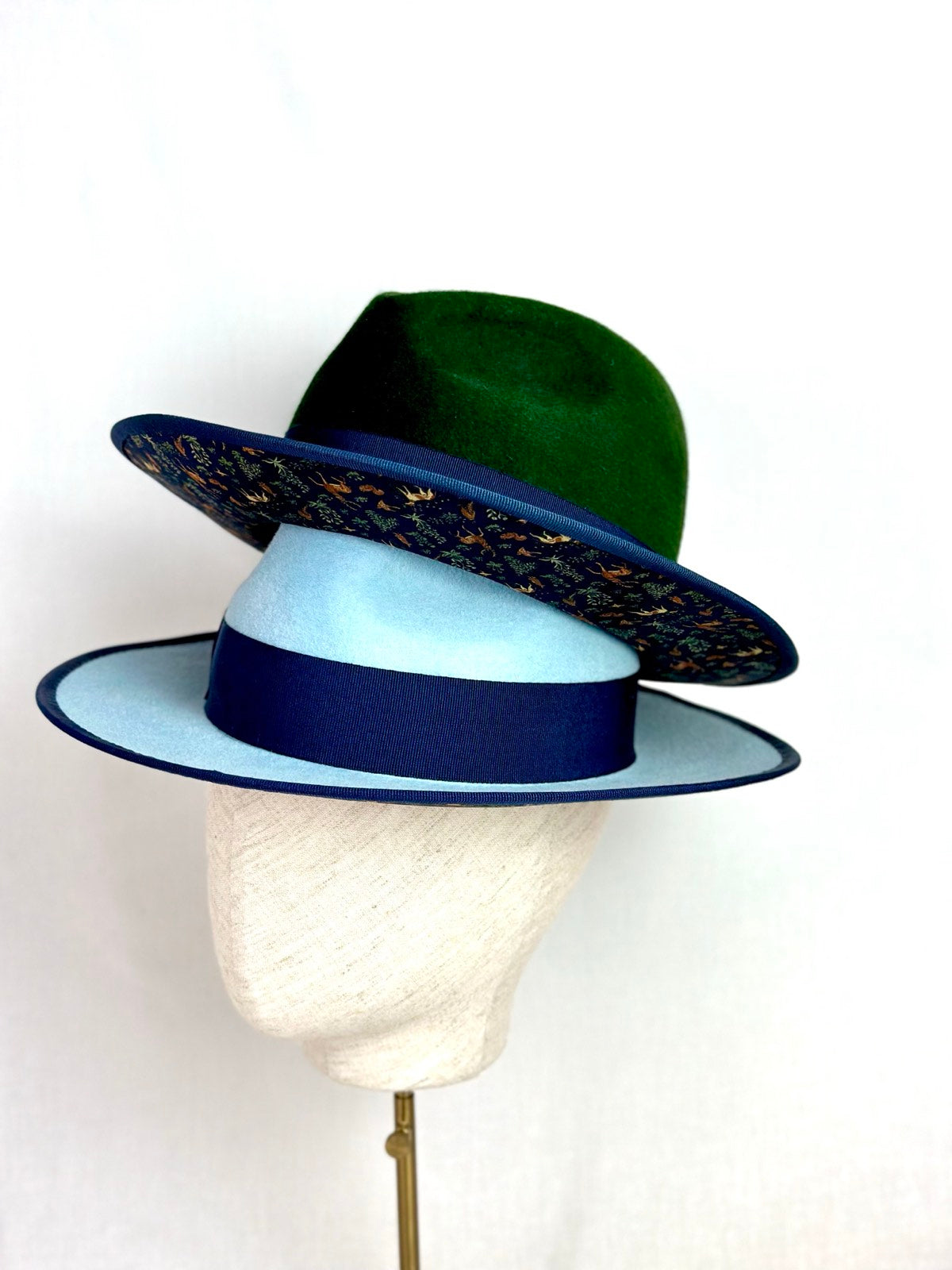
Pale works when the material does the work. Woven straw casts hundreds of tiny shadows across its own surface, which gives the camera detail even at high brightness. A pale colour with something in it holds its identity where optic white gives up: ice blue, oyster, buttermilk, blush and stone. The Classic Parasisal Pillbox in ice blue, £480, shows the principle, since the weave and the straw bow keep their edges in strong light.
If you have set your heart on white, add a tonal trim or a veil. One darker line across a pale crown gives the eye an edge and stops the shape dissolving.
Why do black and navy hats lose their shape detail in photos?
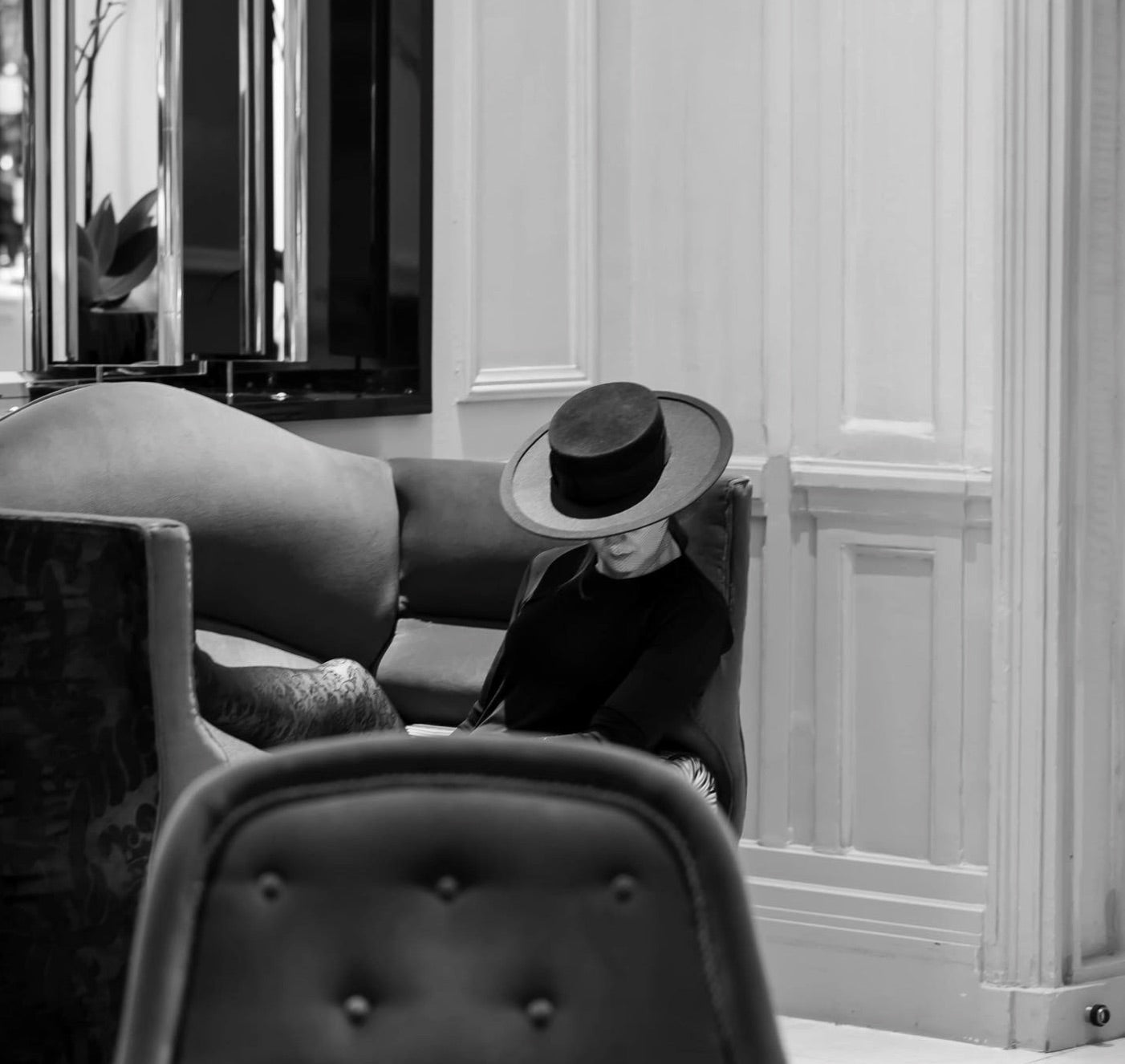
This is the same problem at the other end. Matt black felt reflects very little light, so when the camera exposes for a lit face the hat drops into shadow and the sculpting goes with it. The pinch of a crown and the curve of a brim edge reduce to an outline. Three things rescue a dark colour.
- Surface sheen. Silk velvet, satin and lacquered straw catch directional light and describe their own curves.
- Tonal variation inside the colour. A dark piece carrying a second colour or a motif keeps something legible. The Classic Pillbox Midnight Leopard, £420, works this way, with violet moving through the midnight navy and a leopard motif the camera can resolve.
- Background. A dark hat photographs beautifully against a light sky and disappears against dark trees or a dark suit. Worth deciding where you stand for the formal shots.
How do I stop the brim casting a shadow across my face?
Midday sun and a wide flat brim will put a hard band of shadow across your eyes in every photograph taken outdoors. Most of these fixes are decided at the design stage.
- The underside colour matters as much as the top. A pale underside acts as a reflector and bounces light back into the face. A dark underside deepens the shadow.
- Upturned and open shapes. A brim that turns up, or an open weave that lets light through, keeps the eyes lit.
- Angle. Worn tilted or set back off the hairline, the shadow line moves off the eyes.
- Headpieces sit clear of the face. A pillbox, a bow or a headband leaves the whole face in open light. The Sculpted Felt Bow, £390, sits on a headband colour matched to the wearer's hair with a hidden comb, so the piece reads as sculpture above a lit face and its tonal veil photographs as soft texture.
Should the hat match the outfit or contrast with it?
An exact match is the strongest look and the hardest to achieve. A near miss shows up more in a photograph than in a mirror, because the camera renders both colours under one light and the gap between them becomes the thing the eye lands on. Two other routes work.
- Tonal. The same hue two or three shades deeper than the outfit. This photographs well because it builds a gradient up the body and carries the eye to the face.
- Secondary colour. Take the hat colour from elsewhere in the outfit: the shoes, a trim or one of the quieter colours inside a print. A busy print asks for a plain hat in one of its own colours.
One warning for weddings. White is many different colours. An ivory hat against an optic white dress photographs as dirty, and a bright white hat against a warm ivory dress photographs as cold.
Which hat colours suit different skin tones?
Two things matter here and neither depends on a category. The first is undertone. Hold the fabric under your jaw in daylight and see whether the skin beneath your eyes looks clearer or duller. Do it twice, once by a window and once outdoors, because a colour that flatters indoors can go flat under a grey sky.
The second is reflection. A brim throws its own colour down onto the jaw and neck. Acid yellow, lime and cold green reflect harshly onto most complexions, while warm ivory, soft red, blush and camel bounce a kind light back up. Depth is the mechanical part. Where a hat is much lighter than your face, exposure is pulled towards the hat and the face darkens; where it sits within a step or two of your own depth, the reading stays where you want it. Deep, rich colours therefore photograph reliably across a wide range of complexions.
What do the Royal Ascot rules mean for colour?
Ascot publishes its dress code and reviews it each year, so check the current one before you commission. In the Royal Enclosure, women wear a hat or a headpiece with a solid base of at least 10cm in diameter. That base gives you a real surface, so it is the place for a blocked straw or felt where colour reads across a lawn. Read that requirement carefully if you are drawn to a headband or a small bow, because a piece without a solid 10cm base will not satisfy it. Those pieces belong in the other enclosures and at weddings.
Men in the Royal Enclosure wear black or grey morning dress with a waistcoat and tie, plus a black or grey top hat. A straw fedora is not permitted there. In the Queen Anne and Village Enclosures the requirement is a full length suit with a collared shirt and tie, which is where a fedora earns its place. Our men's hat guide covers the shapes and the fit, and the Royal Ascot collection gathers pieces for the meeting.
Why does a physical swatch settle the colour?
Because a colour name carries no information. Two mills will both call a colour dusty rose and produce two different colours, dye lots move within a single mill, and your phone screen renders its own version of the photograph you took of your dress. The reliable method is a physical swatch, matched by eye under daylight.
Working from a swatch, the straw or felt, the ribbon and the thread are chosen against your cloth in the same light. The colour can also be taken a step deeper for a bright day or warmed for one that will be photographed under cloud. Monika Perlińska blocks and finishes every piece by hand, so any design can be made in another colour and nothing is made twice. Behind that judgement sit around thirty-five years at the craft, beginning at a school of millinery in Poland and an atelier with a century of tradition, then twenty years in London: five in Philip Treacy's atelier, then seven as head milliner at Jane Taylor. There is more about the designer here.
Send a swatch cut from a hem or a seam allowance. A photograph of the fabric will not carry the colour. Allow time before the event and book a fitting in the London atelier or by video call if you are abroad.
If you know the fabric you are wearing, put it in front of a milliner and let the colour be settled against it. You can start a commission here and bring a shape you like as the starting point.