Inside the atelier: the tools and materials of hand-made millinery
A couture hat is shaped over a carved wooden block using steam, tension and drying time, then finished by hand from the inside out. The material sets the limit on how fine an edge can be, the block sets the shape and the stitching decides whether it still holds that shape after a wet afternoon at the races. Those three things account for most of the difference between a hat that goes soft after one season and one that can be steamed back into shape years later.
What is a hat block and why does it matter?
A hat block is a solid wooden form carved to the exact shape of a crown or a brim. Most are lime or jelutong, close grained woods that stay stable under repeated steaming and still take a steel pin without splitting. The wood does none of the shaping on its own. The milliner softens the material with steam and works it down over the block by hand, easing the fullness out so the fibres stretch at the same rate in every direction.
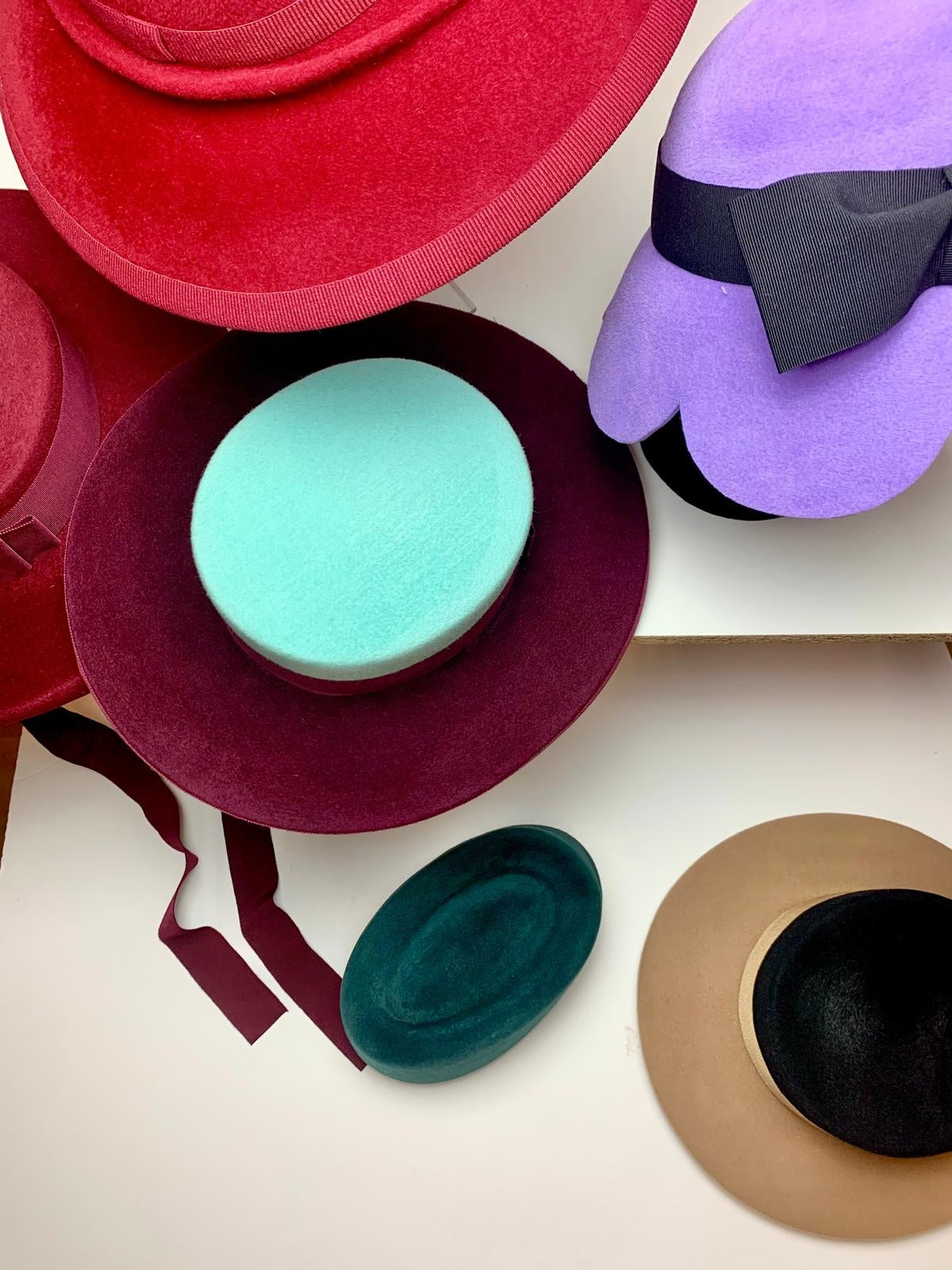
Crowns and brims are usually blocked separately, a crown over a domed or straight sided block and a brim over a flat brim board, then joined. A pillbox is the honest test of a block and a pair of hands, because the shape has nowhere to hide: the sides have to be true, the top flat and the join invisible. That is why a plain shape such as the Classic Parasisal Pillbox in ice blue is one of the harder pieces to make well.
Blocks are sized to the head, so a 57 cm block gives a crown that finishes at around 57 cm once the head ribbon is in. The centimetre ranges listed on each piece describe the finished inside of the hat, so measure around your head just above the ears, keep the tape level and compare against that number. Blocks are also slow and costly to acquire, since a new shape means commissioning one from a block maker and waiting while it is carved. It is one reason a rail of ready made hats tends to repeat the same few silhouettes.
What is the difference between parasisal, sisal, pinokpok and felt?
The material is chosen before the shape, because each one will only go so far.
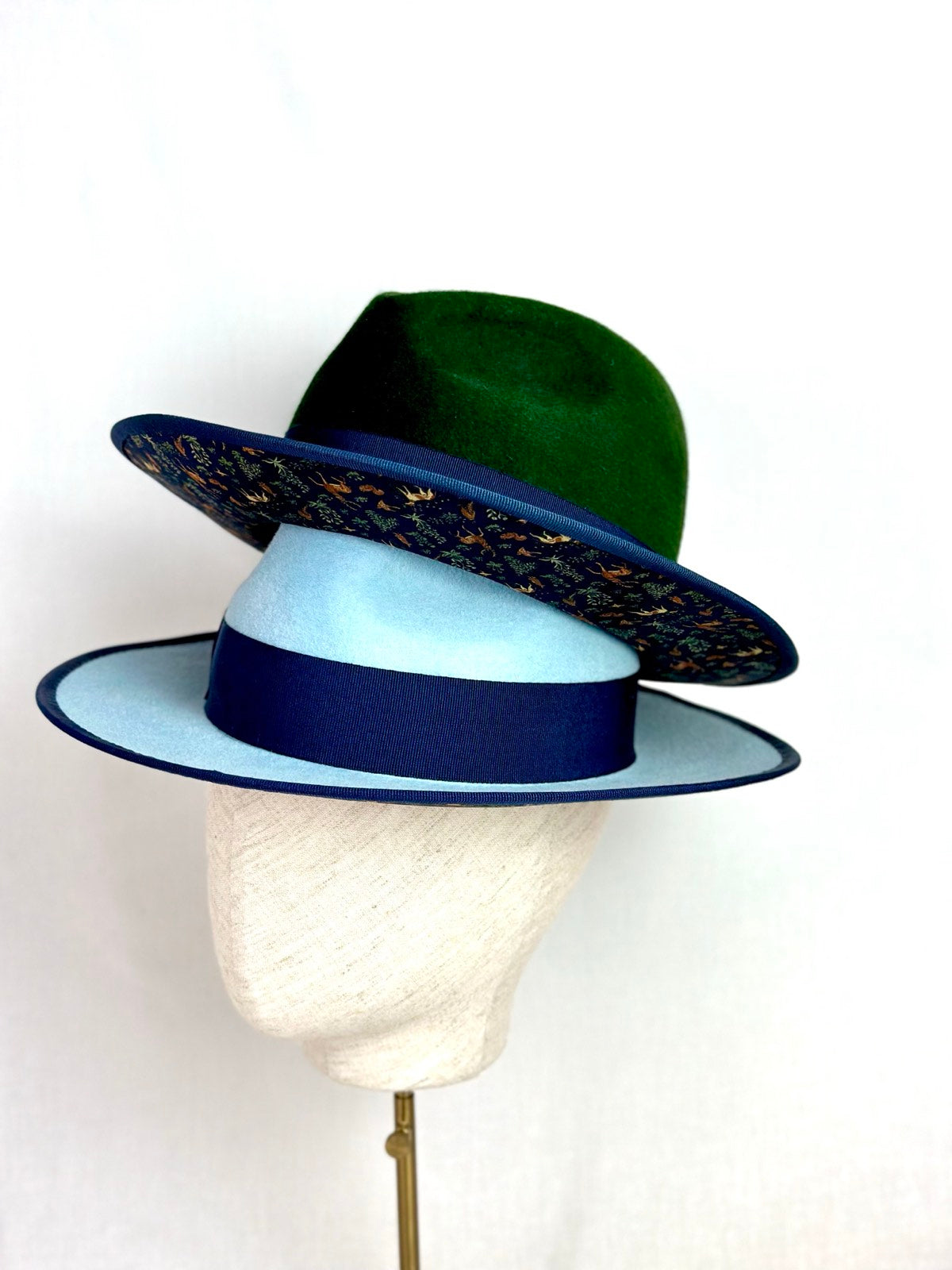
- Parasisal. The finest of the sisal straws, woven very tightly from the fibre of the sisal plant. The surface is smooth and near matte, it takes a crisp brim edge and it holds a sharp line. The Parasisal Fedora in cream uses it for that reason, a soft looking hat that keeps a defined crease.
- Sisal. The same fibre in a more open weave. The texture is visible and it is forgiving over a curve, which gives a relaxed hat with air in it.
- Pinokpok. A Philippine material worked from abaca fibre, beaten out into a fine papery cloth. It is light, matte and slightly irregular, and it holds sculptural folds that straw would fight. That is why the Sculptural Pinokpok Bow Headband can carry a large shape and weigh almost nothing on the head.
- Felt. Wool felt is dense, matte and hard wearing. Fur felt, made from rabbit or hare, is finer and smoother, takes a much sharper edge and costs a good deal more. Felt stretches further than straw under steam, so it reaches shapes straw cannot, as in the Sculpted Felt Bow in scarlet red.
What does blocking a hat actually mean?
Straw and felt arrive as blanks. A hood is a rough cone for a crown; a capeline is a hood with a wide flat brim attached, so both parts of a hat come from one body. The blank goes over steam until the fibres relax, which takes seconds for a fine straw and much longer for a thick felt.
The milliner then pulls the softened material down over the block, sets a cord into the groove most blocks carry at the head line and pins along it with steel blocking pins, easing the excess out a little at a time so no single point takes all the strain. Pull too hard in one place and the weave opens, and an over stretched straw never comes back.
Then it dries, usually overnight in a warm room, and that stage cannot be hurried. The fibre sets to the shape it dried in, which is what makes a blocked hat behave differently from one cut and sewn from flat panels. A blocked crown has no seams pulling against it, so it sits as one continuous surface.
Why does stiffener matter and how much is too much?
Stiffener is a solution brushed into the material to give it backbone, so a brim holds its line in wind and a bow keeps its edge. It goes on in thin coats, each dried before the next, and the quantity is a judgement that depends on the weave, the span of the brim and how the piece will be worn. Too much of it is a common fault in a cheaply made hat: the surface goes hard and faintly shiny and the whole thing feels like board. Applied properly it is invisible, and all you notice is that the brim returns to position after you flex it.
What do grosgrain ribbon, wire and hand stitching do?
Grosgrain is the ribbed ribbon around the crown of a fedora and, inside the hat, the head ribbon. It will not curve on its own, so it is shaped first with steam and a warm iron, stretched along one edge and eased along the other until it forms an arc that lies flat around a curved crown. Skip that and the ribbon ripples, the quickest giveaway on a mass produced hat. The head ribbon is stitched in by hand and it is where the fit is settled, so the last few millimetres of a head measurement are taken up in that seam.
Millinery wire is fine steel wrapped in cotton or rayon so thread will grip it. It runs around the edge of a brim, joined into a ring and attached with a wire stitch, then hidden under a bias binding or a folded edge of the straw. It is what lets a brim turn up on one side or dip at the front, and what lets the shape be nudged back into line years later.
The stitching is done by needle in silk or fine thread, and almost none of it shows from the outside. A machine sews at even tension, which flattens a curve at the point where the curve is doing the work. Hand stitching lets the tension change every centimetre, so the thread pulls hardest where the shape needs holding. Combs, elastics and headband foundations go in the same way, positioned for one head, and a headband is colour matched to the wearer's hair so it disappears.
Why does one pair of hands making the whole piece change the result?
Every stage of a hat rests on a judgement made at the stage before. Whoever blocked the crown knows how far that straw moved, where the weave opened and how much stiffener it drank, and carries that into the wiring and the stitching. Split those stages across a production line and each person assumes an average, so small corrections become compromises the wearer eventually feels.
At Maria Monica London every piece is blocked and finished by Monika Perlińska herself. She qualified at a school of millinery in Poland and refined her craft in an atelier with a century of tradition behind it, then came to London. Five years in Philip Treacy's atelier. Seven years as head milliner at Jane Taylor. Around thirty-five years at the craft, and now her own house.
Does any of this change what you can wear at Royal Ascot?
It changes what to commission. In the Royal Enclosure men wear black or grey morning dress with a waistcoat and tie, along with a black or grey top hat, so a straw fedora is not permitted there. In the Queen Anne Enclosure and the Village Enclosure men wear a full length suit with a collared shirt and tie. Women in the Royal Enclosure need a hat or headpiece with a solid base of at least 10cm in diameter, which a slim headband on its own will not meet. Ascot reviews the dress code each year, so read the current wording before you settle on a shape, and see the pieces gathered for Royal Ascot if that is the occasion you are buying for.
How can you tell hand work from machine work before you buy?
- Look inside first. The head ribbon should be stitched and lying flat, with no ripples and no glue behind it.
- Flex the brim edge. A wired edge gives and returns. An unwired one flops or feels rigid like card.
- Hunt for glue. Shine, stiff patches or a faint smell around trims means glue is doing a job stitching should be doing.
- Weigh it. A properly blocked straw is surprisingly light. Heaviness means excess stiffener or a bulky foundation.
- Look at the crown from above. It should be one unbroken surface, with no seam lines and no flat spot where a press has been.
- Ask whether it can be reshaped. A hand blocked piece can be steamed and reworked years later. A glued and moulded one cannot.
Every piece here is made to order in the London atelier, so the head measurement, the hair colour and the occasion are known before the first steam. Any design can be made in another colour, and nothing is made twice. If you have a shape in mind, you can start a commission and take it from a conversation to a fitting, in London or by video call from abroad.