Trilby vs fedora vs panama: how to tell them apart and which one to wear
A trilby has a narrow brim that turns up sharply at the back and a short crown. A fedora has a wider brim you can wear down all the way round and a taller crown. A panama is defined by its material rather than its shape, because it is woven from toquilla straw in Ecuador and then usually blocked as a fedora. Two of these are shapes. One is a material.
That single distinction settles most of the confusion, and it explains why a hat can honestly be called a panama and a fedora at the same time. Below is the comparison in full, then the rest of the shapes worth knowing. Everything here applies equally to men and women, because a crown and a brim behave the same way on any head.
Trilby vs fedora vs panama at a glance
These are working ranges rather than fixed standards, because every block a milliner owns is cut slightly differently. Use them to name a hat across a room and to judge whether a shape will suit you.
| Attribute | Trilby | Fedora | Panama |
|---|---|---|---|
| Brim width | Narrow, roughly 4cm to 5cm | Medium, roughly 5cm to 8cm | Medium to wide, roughly 6cm to 10cm |
| Crown height | Short, sits high and close | Medium to tall, around 9cm to 11cm | Medium, set by the block it is made on |
| Crown crease | Teardrop or centre dent, sharply pinched | Teardrop or centre dent, softer | Usually a fedora crease, sometimes an optimo ridge |
| Primary material | Felt, or fine straw in summer | Felt in winter, parasisal straw in summer | Toquilla straw from Ecuador, always |
| Formality | Smart casual to smart | Smart casual to smart, the most adaptable | Smart summer daywear |
| UK season | All year in felt | Felt for autumn and winter, straw for spring and summer | Summer only |
| Weather resistance | Almost no shade, felt sheds light rain | Good shade, a snap brim sheds rain off the face | Good shade, heavy rain marks the straw |
What is a fedora and who does it suit?
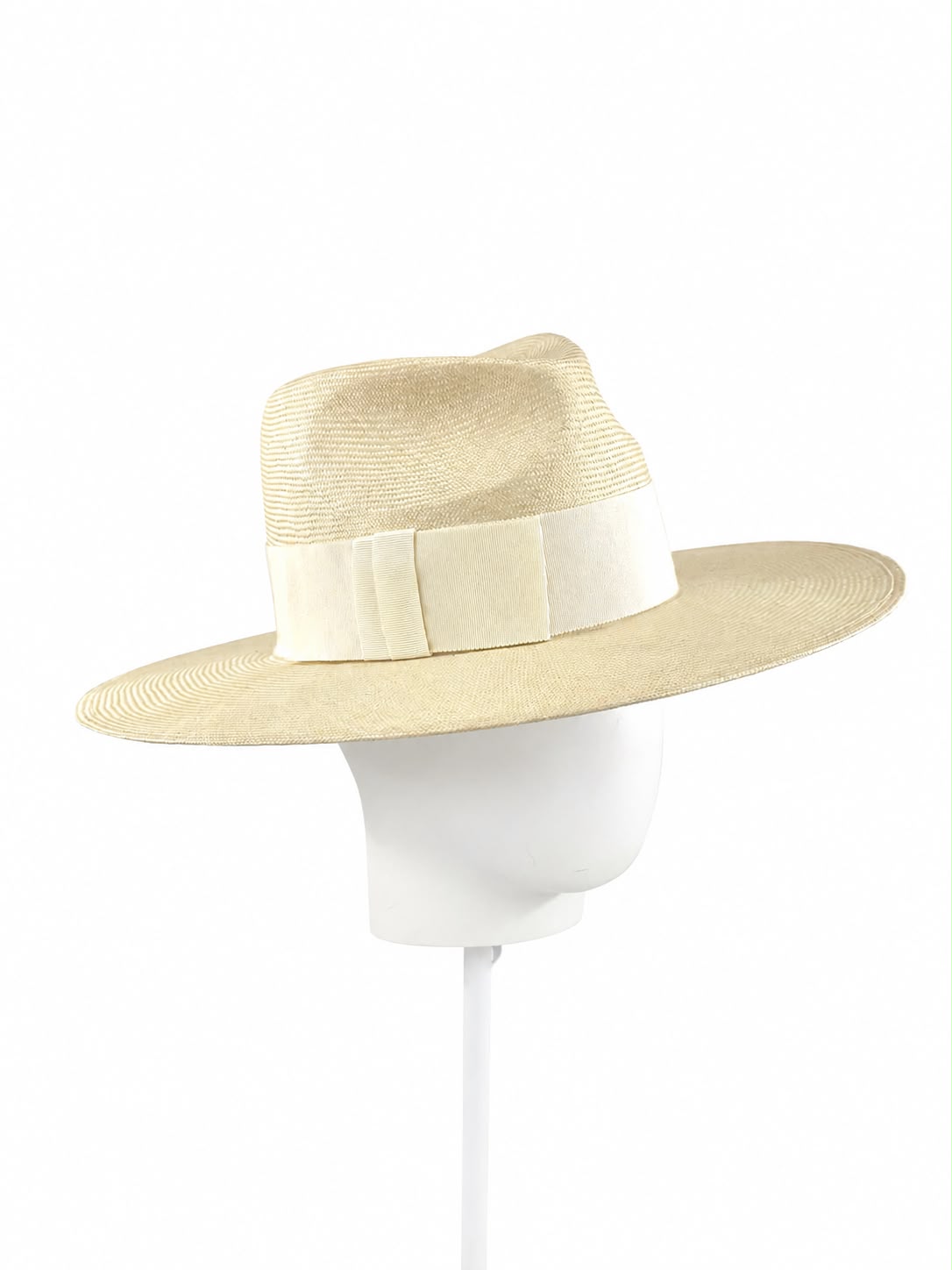
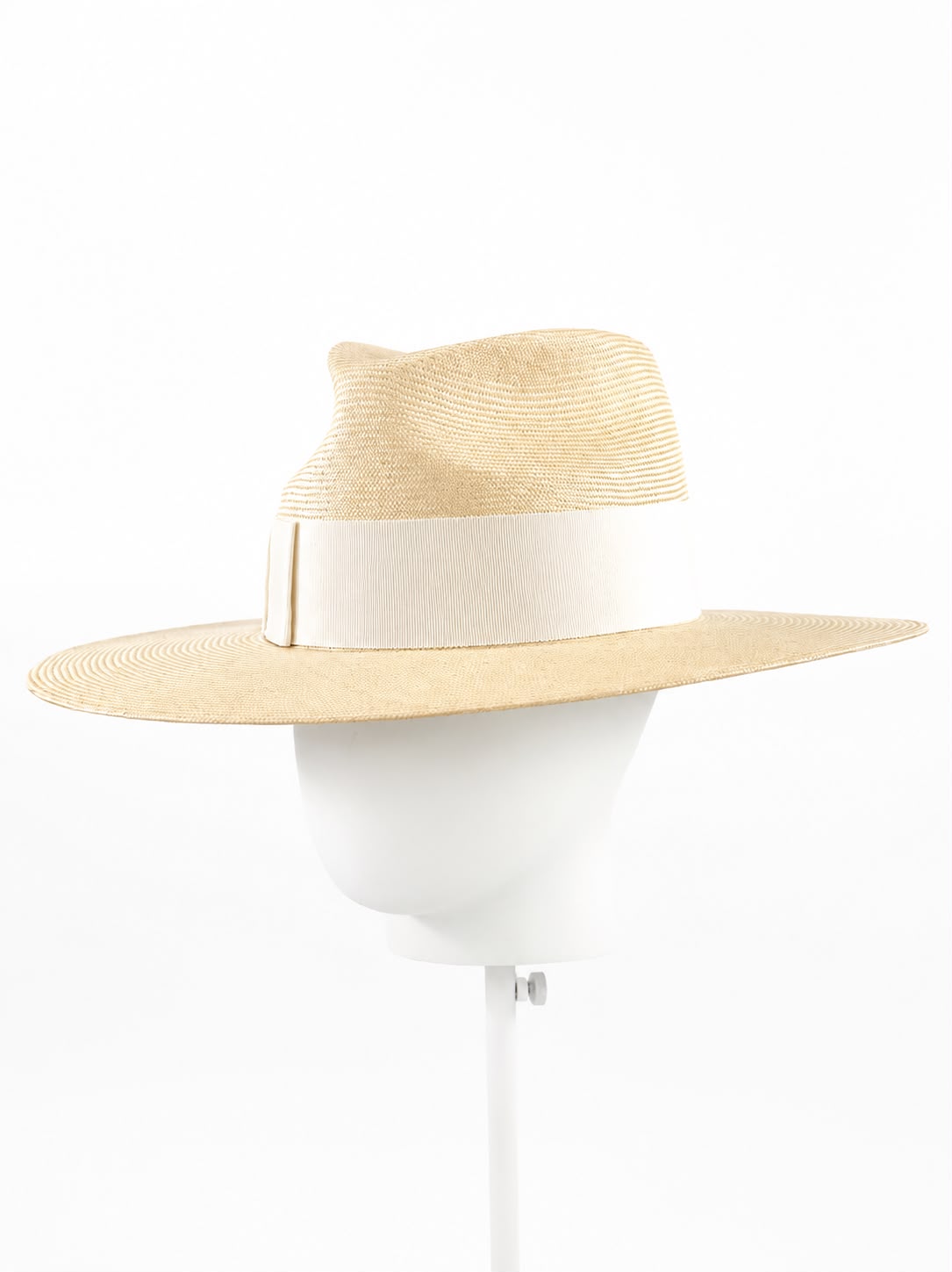
The fedora is the reference point everything else is measured against. It has a soft pinched crown, usually a teardrop or a centre dent, and a medium brim that can be worn snapped down at the front. It works in felt for autumn and winter and in fine straw for summer, which makes it the one shape that covers a whole year.
It suits almost every face because the crease and the brim are both set in the making, so the proportions are decided by the block rather than by how you happen to put it on. If you are choosing your first serious hat, start here. Our Parasisal Fedora in cream, £480, is made in fine parasisal straw with a grosgrain ribbon at the band and cut to 56 to 57cm. It is unisex. For a stronger colour that still behaves as a neutral against navy and grey, the Parasisal Fedora in emerald green, £450, runs 57 to 59cm.
Parasisal is worth understanding before you buy. It is a finely woven straw, lighter and closer in texture than a coarse hood, and it holds a blocked shape without stiffening the whole hat into a shell. That is the difference between a hat that keeps its line season after season and one that softens out of shape by August.
How is a trilby different from a fedora?
The trilby is the fedora's shorter, sharper relation. The brim is narrower, often around 4cm to 5cm, and it is set with a pronounced upturn at the back and a steeper snap at the front. The crown tends to be shorter as well, so the whole hat sits higher and closer to the head.
Because the brim is small, a trilby reads smart and modern. It flatters a longer, narrower face, and it is the more forgiving choice indoors or in a crowd where a wide brim is a nuisance. It gives you almost no sun protection, so treat it as a style decision rather than a practical one. Our Scarlet Trilby, £360, is handcrafted in felt with a suede band, in a colour that carries an outfit on its own.
The quick test in a shop takes two seconds. If the brim is narrow and turns up sharply at the back, it is a trilby. If it is wider, flatter and can be worn down all the way round, it is a fedora.
What makes a panama a panama?
A panama is defined by its material. It is woven from toquilla straw in Ecuador, and it is usually blocked as a fedora, occasionally as an optimo with a ridge running the length of the crown. The finer the weave, the more valuable and the more supple the hat. A panama can therefore be a fedora shape or a trilby shape while remaining a panama.
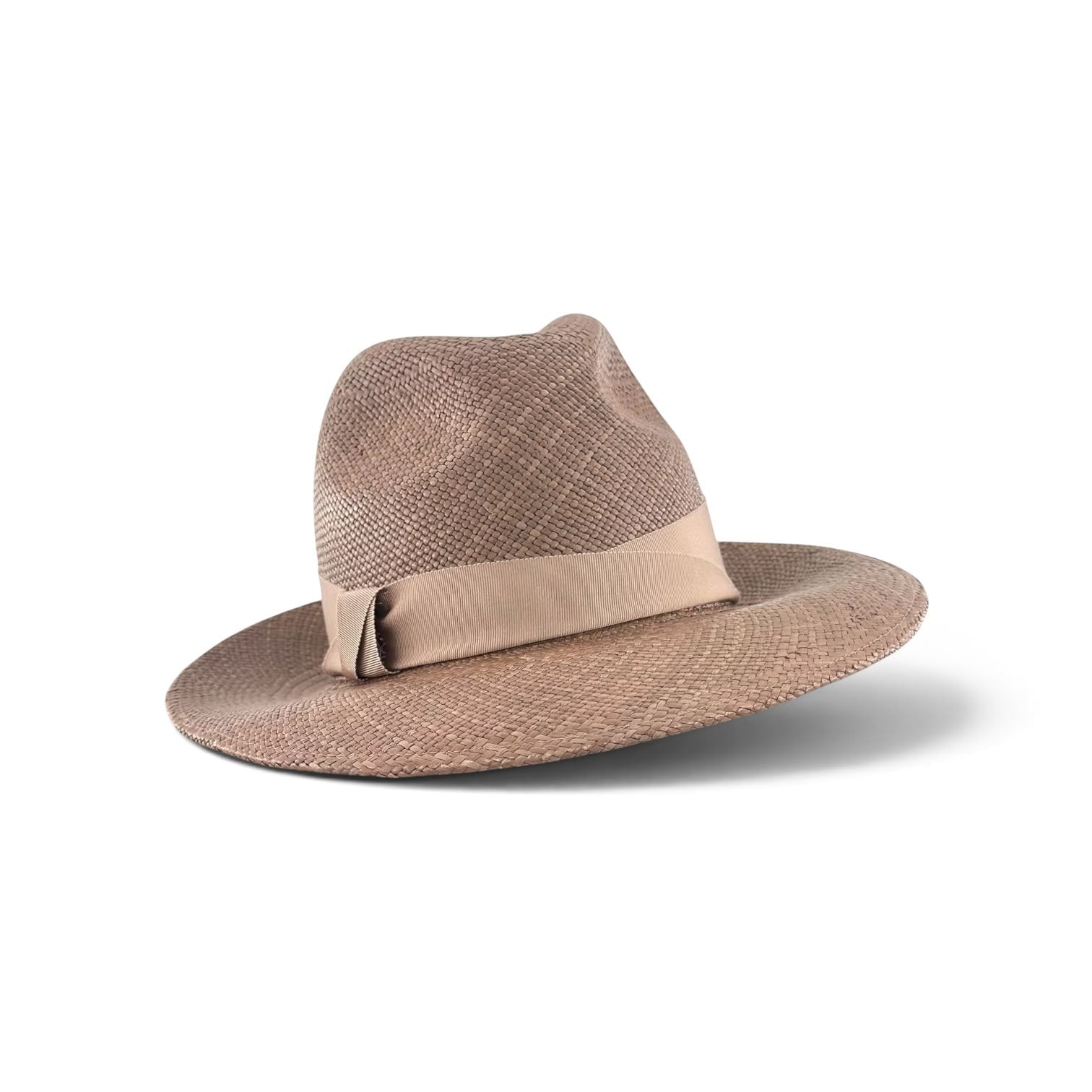
Wear it in summer, in strong light, with light tailoring. It is the correct hat for a garden party, a summer wedding abroad, a race meeting outside the Royal Enclosure, sailing and travel. Because the colour is naturally pale, it lifts a dark suit and it sits easily with linen. Our Panama Trilby in soft cappuccino, £320, is hand-shaped from Panama straw with a tonal grosgrain ribbon and made for women and men alike.
The distinction people get wrong is that any pale straw hat ends up being called a panama. A parasisal fedora and a panama are both fine straws blocked to a similar shape, and they behave differently in the hand. Parasisal has a smoother, more even surface and takes a crisp, sculptural block. Toquilla has a visible woven grain. Neither is superior. They are different finishes for the same season.
Which one should you wear?
Choose a fedora if you want one hat that covers most of the year and most occasions. Choose a trilby if you want something sharp and light for town, you have a longer face and you do not need shade. Choose a panama if the occasion is a British summer day outdoors and the outfit is linen or pale tailoring.
Then check proportion, because it decides more than the name of the shape. The brim should read roughly as wide as your face and no wider than your shoulders. A broad-shouldered person in a narrow brim looks like they borrowed it. A slight frame under a very wide brim disappears. Crown height works the other way: a tall crown adds length to a rounder face, a shallow crown suits a longer one.
See all three shapes together in the fedora and trilby collection.
What do crown shapes actually mean?
The crown is the part of the hat that sits over your head, and how it is creased changes the entire character of the piece. Three creases account for most of them.
- Teardrop. A single dent at the front that tapers back into the crown, so the top view reads as a teardrop instead of a groove running the full length. It is soft and slightly rakish, and it flatters a longer face because the taper stops the crown reading as a tall block.
- Centre dent. A crease running front to back along the middle of the crown, usually with a pinch on each side at the front. It is the most familiar and the most neutral. It draws a vertical line up the centre of the face, which lends height to a rounder or wider face.
- Telescope. The top of the crown is pressed flat and the edge stands up around it like a shallow dish, sometimes called a porkpie set. It reads flatter and more modern, and it suits a narrower face because it adds no visual height.
Crown height matters as much as the crease. As a working guide, a tall crown of around 11cm is dramatic and needs a confident wearer, while a shorter crown of around 9cm sits closer to the head and is easier to carry every day. Crown height varies between blocks, so ask for the measurement before you commit to a piece.
How wide should the brim be?
Brim width is the fastest way to change how a hat sits on you.
- Narrow, under about 5cm. Sharp, urban, close to the head. It reads younger and lighter, and it offers very little shade.
- Medium, roughly 5cm to 7cm. The workhorse. Balanced against most shoulder widths and forgiving under most jackets.
- Wide, 8cm and above. Bolder, more shade, more presence. It needs shoulders to balance it, and it will dominate a slight frame.
How the brim is finished changes things again. A raw or unbound edge is relaxed. A bound edge in grosgrain is dressier. A snap brim, one that can be worn turned down at the front and up at the back, gives you two hats in one and is the most practical choice for a first serious hat.
Assume nothing about your head size until you have measured it. Run a tape around the skull just above the ears and across the widest point at the back, keeping the tape level. That figure in centimetres is your size, and it is the number the sizes quoted on each piece refer to.
The other shapes worth knowing
Three more shapes come up constantly, and each one is easy to identify once you know what to look at.
The boater
The boater is the most rule-bound hat here. Stiff sennit straw, a flat telescope crown, a flat brim of even width all the way round and a wide ribbon band. Nothing about it is soft. It is a summer hat with a narrow set of correct occasions: regattas, cricket, garden events and summer parties with a stated dress code. It carries an association with clubs and colleges, so a striped band can read as a claim you are not entitled to make. If in doubt, take a plain band. See our boaters.
The flat cap
The flat cap is the only shape here with no separate brim. A rounded body sits low over a short stiffened peak and the two are joined at the front. A classic cap is close-fitting, a baker boy or eight-piece cap has more fullness in the crown. It belongs to daylight, country and casual town wear, in tweed for the cold months and linen or cotton for summer. It sits badly with a morning coat or black tie. A fuller crown flatters a longer face and a flatter, closer cap suits a rounder one.
The homburg
The homburg is the dress hat. Stiff felt, a single centre dent in the crown with no side pinches, and a brim bound in grosgrain and curled up all the way round in a fixed line. The brim never snaps down, and that fixed curl is the giveaway. It is the most formal soft-felt hat there is and it sits between a fedora and a top hat in register. Wear it with a dark overcoat in winter for occasions with weight to them.
Which hats are allowed at Royal Ascot?
Ascot is where hat choice stops being taste and becomes a rule, so it is worth knowing the published code. Codes are reviewed each year, so check the current one before you commit to a piece.
- Royal Enclosure, men. Black or grey morning dress with a waistcoat and tie, plus a black or grey top hat. A straw fedora is not permitted in the Royal Enclosure, however fine the straw.
- Queen Anne Enclosure and Village Enclosure, men. A full length suit with a collared shirt and tie. The published code sets no hat requirement for these enclosures, which is where a fedora or a panama sits comfortably.
- Royal Enclosure, women. A hat or headpiece with a solid base of at least 10cm in diameter.
If you are dressing for a race meeting, start with the Royal Ascot collection, and the men's hat guide covers the men's shapes in more detail.
Questions
What is the difference between a trilby and a fedora?
A trilby has a narrow brim of roughly 4cm to 5cm that turns up sharply at the back, and a short crown that sits high on the head. A fedora has a wider brim of roughly 5cm to 8cm that can be worn down all the way round, and a taller crown. The trilby reads sharper, the fedora more classic.
Is a panama hat a fedora?
Usually yes in shape, though the two words describe different things. Panama refers to the material, a straw woven from toquilla palm in Ecuador. Fedora refers to the shape, a pinched crown with a medium snap brim. Most panamas are blocked as fedoras, so one hat can accurately be called both.
Which is more formal, a trilby or a fedora?
A fedora, by a small margin, because the fuller brim and taller crown read as more traditional. Both sit in smart casual to smart territory, and the finish moves them further than the shape does. A bound grosgrain edge and a felt body dress either shape up, while a raw edge relaxes it.
Can women wear a fedora, a trilby or a panama?
Yes. All three are unisex shapes and always have been. Fit and proportion decide whether a hat suits you rather than who it was originally cut for. Our Parasisal Fedora in cream and our Panama Trilby are both made and sized as unisex pieces, and any shape in the house can be blocked to your own head measurement.
Can you wear a panama hat in winter?
No, keep it for summer. Toquilla straw is a warm weather material, it reads out of season against winter tailoring and heavy rain marks it. The winter equivalent of a panama is the same shape blocked in felt, which gives you the fedora line with a material that suits cold, wet British months.
How do I know what size hat to buy?
Run a tape measure around your head just above the ears and across the widest point at the back, keeping it level. That figure in centimetres is your size, and it is the number quoted on each piece. Measure before you order, because head sizes are rarely what people assume.
What is a snap brim?
A snap brim is a brim that can be worn turned down at the front and up at the back, or flat all the way round. It gives you two looks from one hat and it sheds rain off the face when it is snapped down. It is the most practical choice for a first serious hat.
Browse the fedora and trilby collection, or start a commission if you have an occasion in mind and want the fit taken properly. Every piece is blocked and finished by hand by Monika Perlińska in the London atelier, made to order, and any shape can be made in another colour. Fittings happen in the atelier, or by video call if you are abroad. Delivery within the United Kingdom is £20.00.