How to choose a men's hat for your face, height and build
Four checks settle most of a men's hat decision. Measure your head where the band will actually sit, match the brim width to your shoulders, match the crown height to the length of your face, then confirm the finished hat sits level with the band about a centimetre above the ears. What remains after that is hair, glasses and an honest look at your own proportions.
How do I measure my head for a hat?
Use a soft tailor's tape. Run it around the head about a centimetre above the ears and across the middle of the forehead, roughly a finger's width above the eyebrows. That line is where the inner band of a finished hat sits, and it is lower than most people assume. Measure higher up, around the widest part of the skull, and you will read one to two centimetres small and have a headache by lunchtime.
A few things that improve the number:
- Keep the tape level all the way round. Let it drop at the back and you lose half a centimetre.
- Snug, without compressing the skin. If the tape leaves a mark, it is too tight.
- Measure three times and take the largest reading.
- Measure in the afternoon. Heads can swell slightly through the day, and a hat fitted to a morning measurement will feel tight by six.
- Measure with your hair as you actually wear it, styled and dry.
Write it down in centimetres to the nearest half. Adult men most often measure between 56 and 61 cm. Anything above or below that is common enough, and it is one of the practical reasons to have a hat blocked to your own measurement.
What does a hat size in centimetres actually mean?
The figure quoted against a hat is the internal circumference at the band, measured on the finished piece. A hat listed at 57 to 59 cm has been made to sit comfortably across that span. Buy at the very top of a range and the hat drops onto your ears in a breeze. Buy at the very bottom and you will have a red line across your forehead within the hour.
Material changes how much forgiveness you have. Fine parasisal straw holds its blocked shape and gives almost nothing once finished, so the number matters more. Felt has a small amount of movement in it and can be persuaded a little at fitting. If you sit between two sizes, take the larger one and have the band padded at a fitting. Straw cannot be stretched once it is finished.
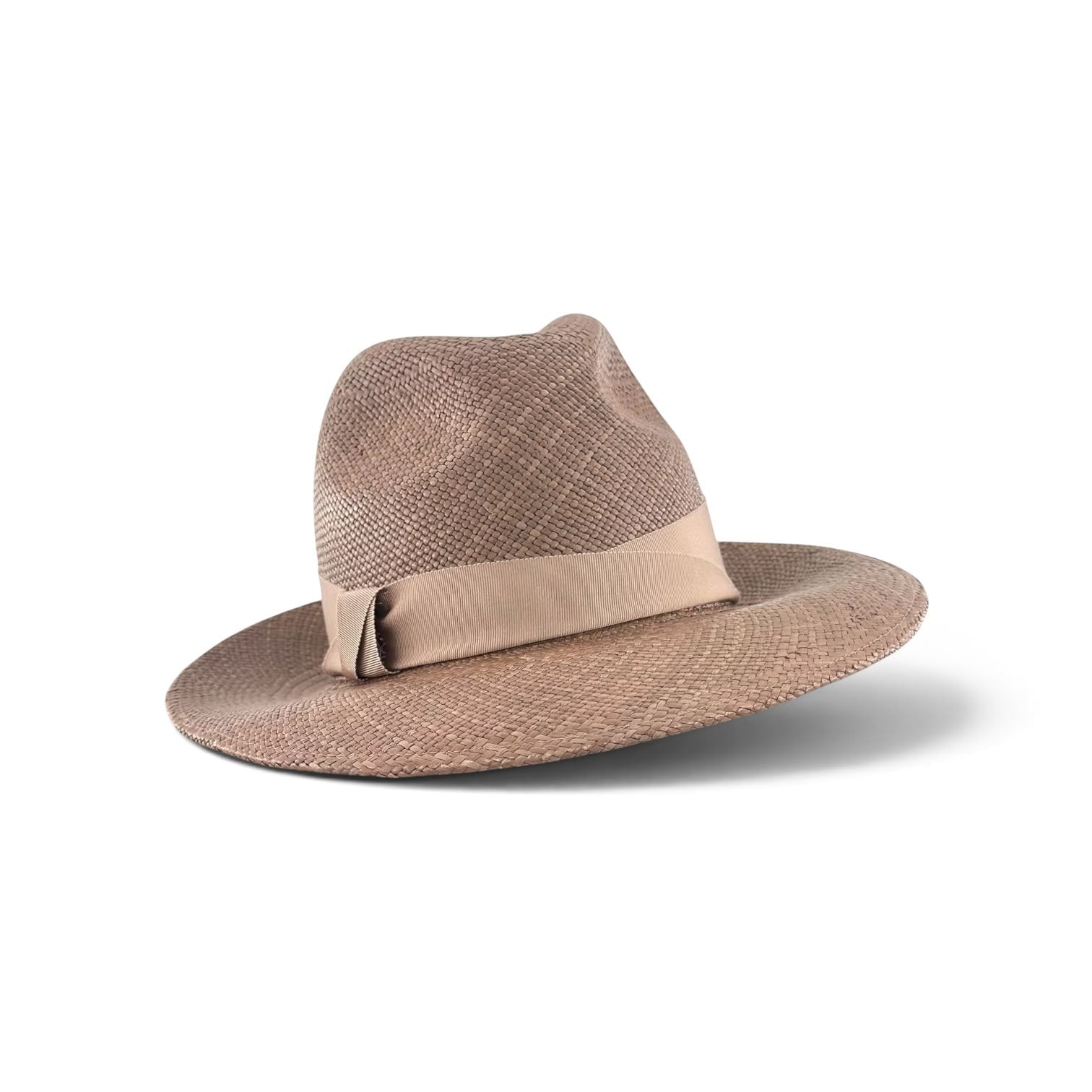
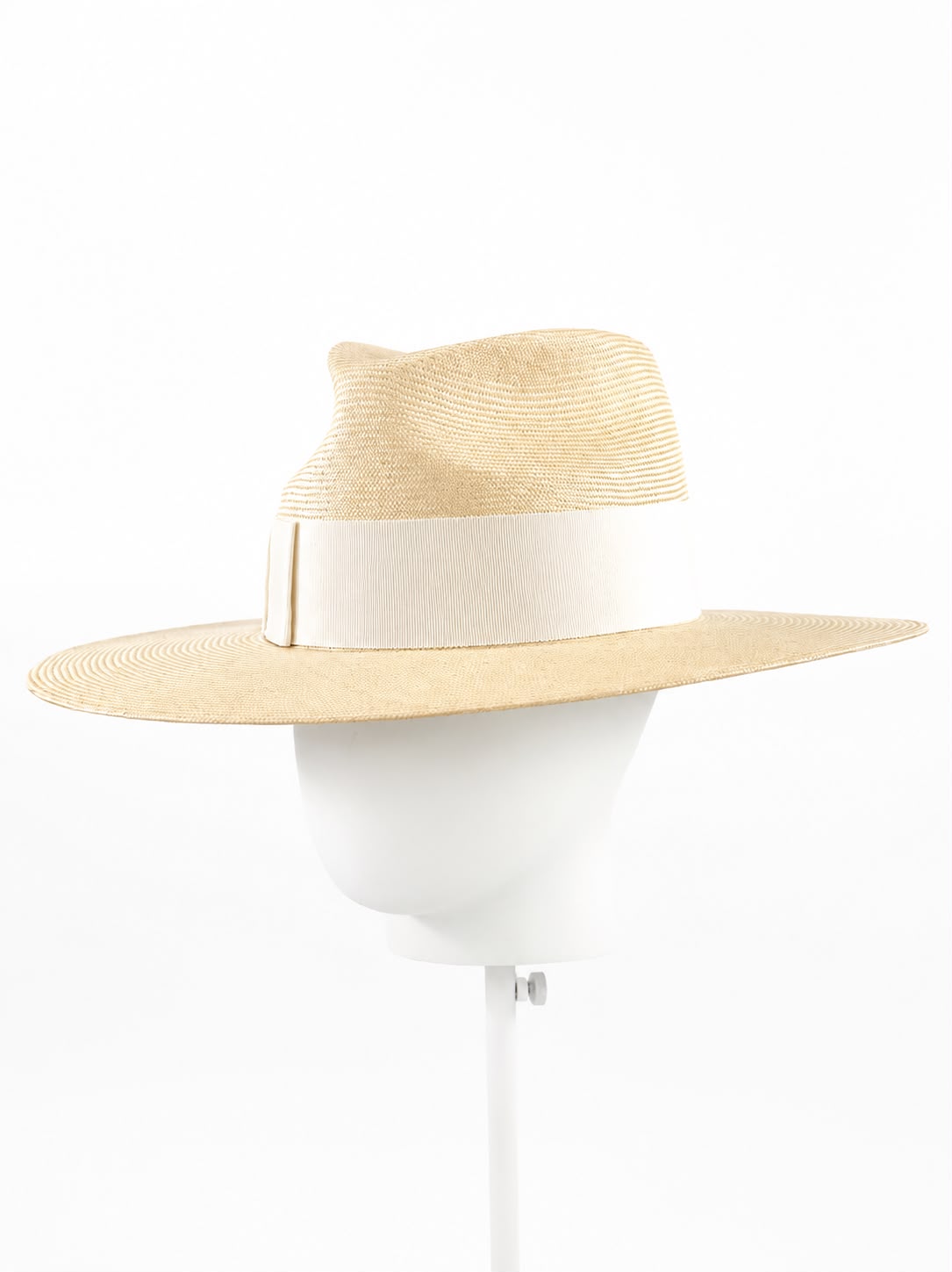
Our Parasisal Fedora in cream is finished at 56 to 57 cm, and the same fedora in emerald green runs 57 to 59 cm. A couple of centimetres decides who a given hat is for. Every piece is made to order, so a head measurement outside those ranges simply means a different block.
How wide should the brim be for my shoulders?
The brim is read against the width of your shoulders, and the eye is unforgiving about it. A useful test: stand square to a mirror or have someone photograph you head on from two metres. Look at where the brim edge finishes in relation to the point of each shoulder. If the brim reaches much beyond a third of the way out to the shoulder point, it is wide for your frame and will read as costume.
As a starting range, a man with a narrow frame is well served by a brim of 5 to 6.5 cm. An average build sits comfortably at 6.5 to 8 cm. Broad shoulders and a large head can carry 8 to 9 cm and will look under-dressed in anything narrower. The mistake made most often is the narrow brim on the wide man, which shrinks the head and makes the body look heavier.
How tall should the crown be for my face?
Crown height answers to face length, measured from hairline to the base of the chin. A long face gains nothing from a tall crown, because the two stack and the whole head reads longer still. A short or round face disappears under a low, flat crown, since there is no vertical line anywhere to break up the circle.
Judge the crown with the hat on, from the side. The silhouette you want is the head plus the crown reading as one balanced shape. If the crown looks like a separate box parked on top, it is too tall or too straight-sided for you. Tapered crowns and a deep teardrop crease are quieter on most faces than a hard, upright cylinder.
What suits a round face and what suits a long face?
For a round or square face, look for a crown with some height and a defined crease, and a brim with a slight downward snap at the front. Angular lines cut across the softness of the face and give the eye something vertical to follow. Keep the brim moderate; a very wide flat brim will widen you further.
For a long or narrow face, lower the crown and widen the brim. Horizontal weight at eye level shortens the face. A flat-set brim works well here, and a low crown with a centre dent is a safe place to start. Avoid the combination of tall crown and narrow brim, which is the single most lengthening shape available.
An oval face tolerates most shapes, so the decision moves entirely to height and build. A heavy jaw softens under a rounded crown; sharp features carry crisp, pressed lines comfortably. None of this is a rule you cannot break, and all of it is easier to see in a mirror than on paper, which is what a fitting is for. The men's hat guide sets out the shapes we block and what each one does to a face.
Do height and build change the answer?
Yes, and more than face shape does. Under about 5ft 8in, scale everything down: a brim past 7 cm and a tall crown will make you look shorter, because the eye reads the hat as a horizontal lid. Over 6ft, do the opposite. Small hats on tall men look borrowed. A slim tall man can take real crown height. A tall, heavy man wants width in the brim to keep the head in proportion with the shoulders.
Build matters at the band as well as the brim. A large head on a slight frame needs a shallower crown to stop the whole silhouette going top-heavy. Straw reads lighter than felt at the same dimensions, which is worth knowing if you like the shape of a hat but find it dominating in the mirror.
How do glasses and hair change the fit?
Try every hat with your glasses on, every time. The brim should clear the top of the frames cleanly. If the hat pushes the arms of your glasses down or the brim edge cuts a hard shadow across the lenses, the crown is sitting too low on the head or the brim angle is too steep at the front. Heavy frames already draw a strong horizontal line across the face, so pair them with a moderate brim and let one of the two lines do the work.
Hair is part of the measurement. Thick or curly hair can add close to a centimetre, and a short back and sides in July will leave a hat loose that fitted in March. If your cut changes with the season, size for your fuller hair and have the band taken in when it is short. A shaved head puts the band directly against skin, so the quality of the ribbon and the finish inside the hat becomes the difference between wearing it all day and taking it off after twenty minutes.
How should a hat sit on the head?
Level. The brim should be roughly parallel to the floor, and the band should sit about a centimetre above the top of the ears, all the way round. The front edge belongs just above the eyebrows, close enough to shade the eyes and high enough that you can see the horizon without lifting your chin.
Two quick checks before you commit. Nod firmly and turn your head sharply; a correctly sized hat stays where it is. Then wear it for twenty minutes and take it off. A faint line on the forehead is fine; a deep red groove means it is too small. Pushed back on the crown, a hat reads careless. A slight tilt is a signature that only works when the fit underneath it is exact.
Which hat is permitted at Royal Ascot?
The enclosure codes are specific and are reviewed each year, so read the current one before you order. In the Royal Enclosure, men wear black or grey morning dress with a waistcoat and tie, together with a black or grey top hat. A straw fedora is not permitted there. In the Queen Anne Enclosure and the Village Enclosure, men wear a full length suit with a collared shirt and tie, and a fine straw fedora sits comfortably within that requirement. If you are ordering for a companion at the same time, the Royal Enclosure asks women for a hat or headpiece with a solid base of at least 10cm in diameter. Pieces we make for the meeting are gathered in the Royal Ascot collection.
If you know your measurement and your proportions, the rest is colour and shape, and both are open. Every hat in the men's collection is blocked and finished by hand in the London atelier by Monika Perlińska, who spent five years in Philip Treacy's atelier and seven as head milliner at Jane Taylor before opening this house. Any piece can be made in another colour and to your own head size. Fittings take place in the atelier or by video call if you are abroad. When you are ready, start a commission and we will begin with the measurement.